20 May, 2026
THE LONG-NOSED PRIMATE OF KEHJE SEWEN FOREST
BIODIVERSITY
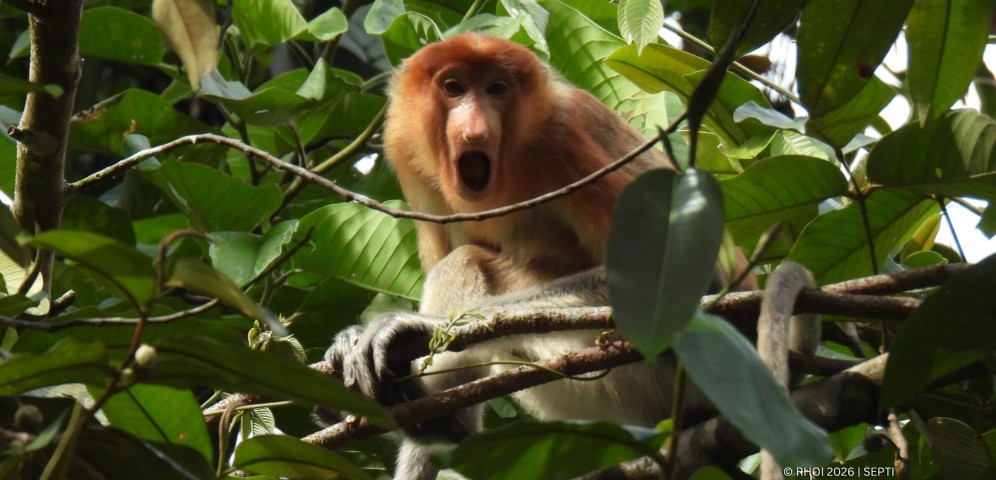
An exciting encounter occurred when our Biodiversity–Post Release Monitoring (B-PRM) team conducted a patrol in Kehje Sewen Forest, East Kalimantan. During the patrol, the team successfully observed one of Borneo’s endemic primates, well known for its distinctive long nose—the proboscis monkey (Nasalis larvatus).
Getting to Know the Proboscis Monkey (Nasalis larvatus)
The proboscis monkey is one of the most easily recognizable primates in the world. Its most distinctive feature is its long, pendulous nose, which is especially prominent in males. This unique nose plays a role in vocal communication and is believed to help attract females.
Proboscis monkeys are covered in reddish-brown to orange fur along their backs, while their underparts tend to be lighter in colour. Their pale faces give them a distinctive expression. Compared to many other monkey species, proboscis monkeys are relatively large, with body lengths ranging from 60–75 cm, not including their long tails.
Another notable characteristic is their large, pot-bellied stomach, an important adaptation that helps them digest leaves, which make up a significant portion of their diet.
Habitat and Distribution
As an endemic species of Borneo, proboscis monkeys are naturally found only on the island, including Kalimantan (Indonesia), Sabah and Sarawak (Malaysia), and a small part of Brunei Darussalam.
These primates typically inhabit peat swamp forests, mangrove forests, and riparian forests along rivers. They depend heavily on tall trees near water sources for feeding, resting, and protection from predators.
Although they are best known as inhabitants of coastal and riverine habitats, proboscis monkeys can also occasionally be found in lowland forests that still provide adequate water sources and dense vegetation. The presence of proboscis monkeys in the Kehje Sewen Forest indicates that this ecosystem continues to provide suitable habitat. not only for orangutans but also for other primates such as the proboscis monkey.
Feeding Habits and Behaviour
Proboscis monkeys are herbivorous primates, with young leaves forming the main part of their diet. In addition to leaves, they also consume fruits, seeds, and flowers from a variety of forest plants.
Their digestive system is particularly unique, featuring a multi-chambered stomach that allows them to break down high-fibber plant materials through microbial fermentation.
Proboscis monkeys usually live in social groups, typically consisting of one adult male, several females, and their offspring. They are active during the day and often move agilely from tree to tree through the forest canopy. In their natural habitat, they are also known to be excellent swimmers, capable of crossing rivers to move between territories.
Reproductive Behaviour
Within proboscis monkey social groups, a dominant adult male typically leads a group of several females. The breeding season is not strictly tied to a particular time of year. However, females usually give birth to a single infant after a gestation period of approximately 166 days.
Newborn proboscis monkeys have bluish faces and darker fur compared to adults. The infants depend heavily on their mothers during the first few months of life before gradually learning to forage and interact with other members of the group.
Conservation Status and the Importance of Habitat Protection
According to the IUCN Red List, the proboscis monkey (Nasalis larvatus) is currently classified as Endangered (EN). The decline of this species is mainly driven by habitat loss due to deforestation, land conversion for plantations, and forest fragmentation.
Because proboscis monkeys rely heavily on riverine and riparian forest ecosystems, habitat degradation can have a direct impact on their survival in the wild.
These encounter with a proboscis monkey in Kehje Sewen Forest is more than just a wildlife observation, but also a reminder of the importance of protecting Borneo’s tropical forests. Alongside orangutans, forest birds, and various other mammals, the proboscis monkey is part of an interconnected web of life within this ecosystem.
- Share
-

-