09 Nov, 2026
Accelerating Releases with Pontoons
CONSERVATION SUPPORT
On November 6th, a collaboration between the Ministry of Forestry of the Republic of Indonesia, the Nusantara Capital City (IKN) Authority, the East Kalimantan BKSDA, and the BOS Foundation successfully released orangutans Catherine, Dennis, and Ames into the Kehje Sewen Forest.
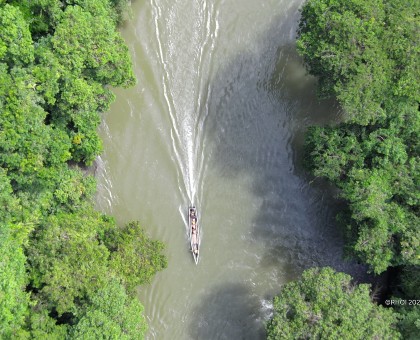
However, returning orangutans to the wild is no simple task. The forests where orangutans are released are often located in areas with challenging terrain to traverse. To address this challenge, PT RHOI prepared an unconventional mode of transport for rivers with strong currents and low water levels—a pontoon—which performed far beyond expectations.
The Role of Pontoons in Accelerating the Orangutan Release Process
When orangutans are finally declared physically, medically, and behaviorally ready for release, the next challenge is: how to prepare operations to support the release process?
This is where pontoons play a crucial role. Designed specifically to carry heavy loads, in the context of release operations, pontoons function as the main logistical and accommodation bridge connecting land vehicles that cannot cross the river.
Pontoons are operated by PT RHOI to support the release stage, such as accelerating the delivery of essential logistics needed during the release process. As a result, all preparations can be completed much faster.
Challenges of Operating Pontoons on the Telen River
Although pontoons offer a highly efficient logistical solution, their field operation is far from easy. The Telen River, which serves as the primary water artery leading to and surrounding the Kehje Sewen Forest area, presents a natural landscape full of extreme dynamics and challenges, such as:
Water Volume and Depth Fluctuations
One of the biggest challenges faced by PT RHOI's pontoon boat operators is the rapid and unpredictable change in the Telen River's water volume. Kalimantan is known for its tropical climate with high rainfall intensity, but it can also experience dry spells that cause river water levels to drop drastically.
Navigating Driftwood and Narrow Channels
The Telen River flows through dense forest, meaning the surrounding natural vegetation is highly active. Large trees uprooted by riverbank erosion frequently drift downstream. Submerged logs can damage the pontoon's propeller or even its hull.
In addition to drifting wood, several segments of the Telen River feature natural narrow passages and small rapids. Navigating a relatively large pontoon through narrow water gaps requires precise coordination among the boat crew.
The successful release of orangutans back into the Kehje Sewen Forest is the result of an interconnected chain of hard work. Maximizing pontoon operations by PT RHOI proves that every technical detail has a direct impact on the safety of every individual involved in the orangutan release process.
Text by: POC Camp Nles Mamse PT RHOI, East Kalimantan
- Share
-

-